Member Updates
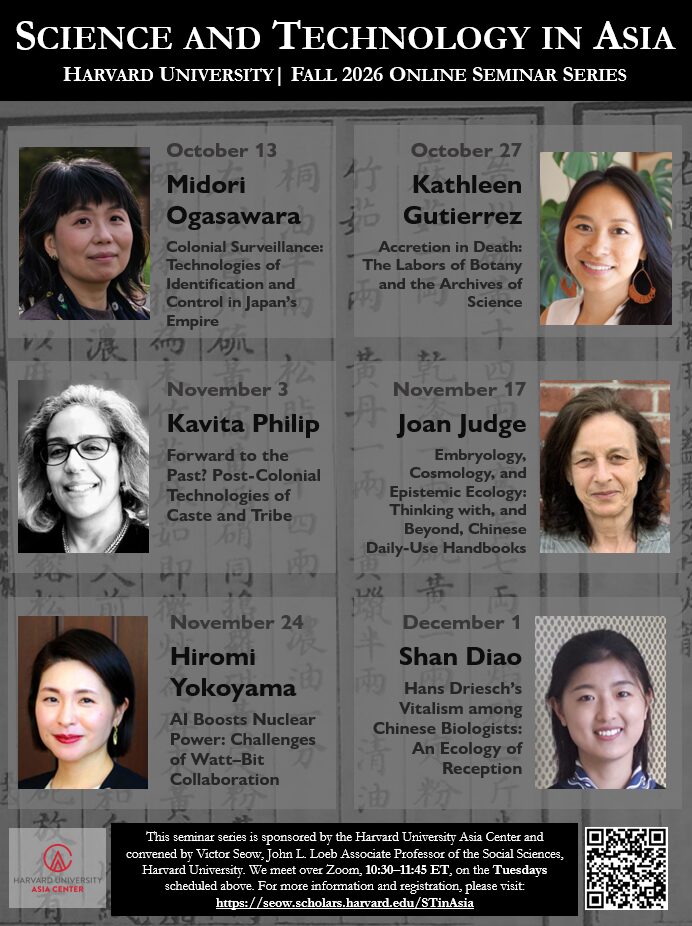
Embryology, Cosmology, and Epistemic Ecology: Thinking with, and Beyond, Chinese Daily-Use Handbooks
Online Seminar series organized by Harvard University Asia Center, November 17, 2026.
Seminar by: Joan Judge
Joan Judge’s seminar, titled “Embryology, Cosmology, and Epistemic Ecology: Thinking with, and Beyond, Chinese Daily-Use Handbooks,” will introduce her research on the sources, origin, content, and circulation the section on “Planting Seeds/Gestation” in the Chinese daily-use compendia the 萬寶全書 (Complete compendium of myriad treasures).
Register here to attend the lecture series.
Visit the website of Harvard University – Science and Technology in Asia for more information.
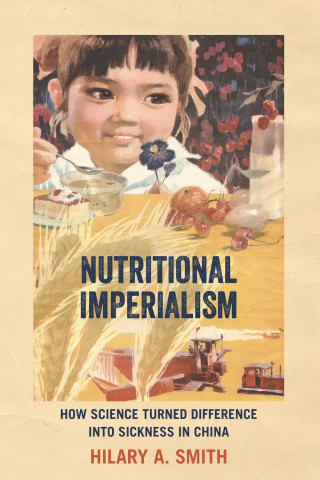
Nutritional Imperialism
How Science Turned Difference into Sickness in China.
Book project by: Hilary Smith
For more than a century, Western observers have treated Chinese foodways as evidence of deficiency, danger, or backwardness. In Nutritional Imperialism, Hilary A. Smith shows how these assumptions entered the heart of modern nutrition science and reshaped understandings of health, diet, and difference. Nutrition scientists, physicians, and policymakers presented Western dietary patterns as universal benchmarks of health and transformed ordinary physiological variation into signs of pathology.
Visit the website of the Johns Hopkins University Press for more information.
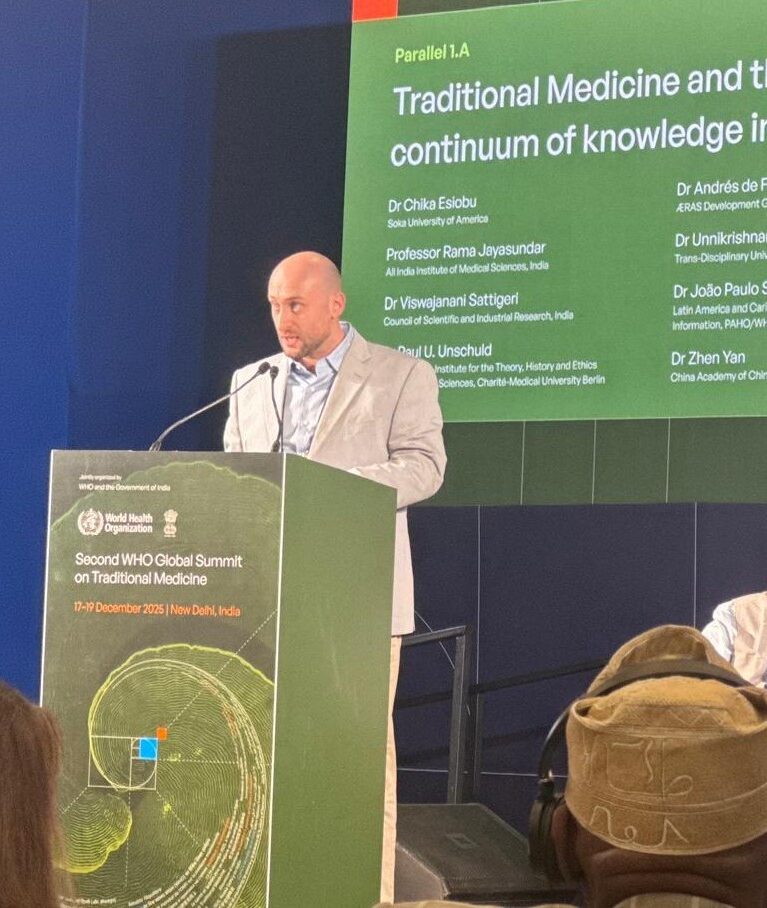
Traditional Medicine as an Integral Component of Global Healthcare Systems
Talk at the Second WHO Global Summit on Traditional Medicine – New Delhi. December 17-19, 2025.
Presented by: Joachim Prackwieser, in collaboration with Paul Unschuld and Nalini Kirk
The WHO Global Summit on Traditional Medicine in New Delhi, India, convened international experts from the fields of policy, science, and clinical practice to reimagine the role of traditional medicine within global healthcare frameworks. Representing Professor Paul U. Unschuld, Joachim Prackwieser from the Institute for Chinese Life Sciences at the Charité Competence Center for Traditional and Integrative Medicine (CCCTIM), presented the historical and ethical dimensions of Chinese medicine, demonstrating that medical knowledge has not evolved along a linear path of progress but has been shaped by shifting power asymmetries.
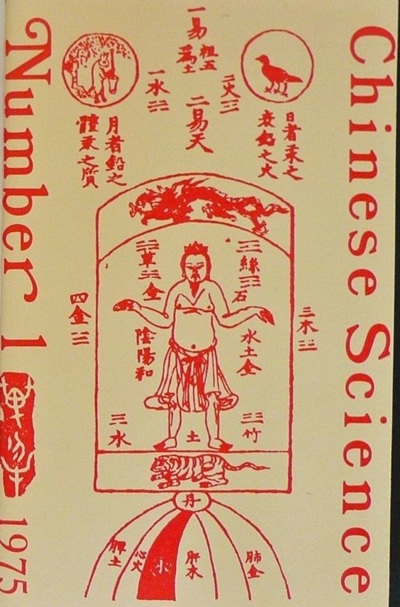
“Beyond Classical Chinese Medicine”
Special Issue in East Asian Science, Technology, and Medicine (EASTM), Volume 57, Issue 2 (2025).
Includes articles by: Marta Hanson, Asaf Goldschmidt, Che-chia Chang
This fiftieth anniversary special issue of the journal East Asian Science, Technology, and Medicine (previously known as Chinese Science) pays tribute to the scholarly legacy of the late Professor Nathan Sivin (1931–2022), the founder and first editor-in-chief of the journal. The issue contains articles written by collaborators on the Vernacular Medicine and Modes of Knowing in China project.
Visit the website of East Asian Science, Technology, and Medicine (Brill) for more information.
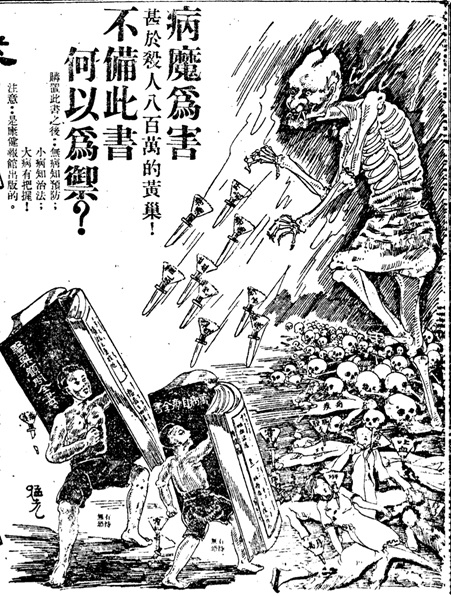
Medical Advertising in Republican China
Analyzing two medical advertisements from Shenbao 申報.
Translation by: Hugh Shapiro
Advertisements in Shenbao, one of China’s most widely read newspapers of the Republican period (1912-1949), show diverse socio-cultural phenomena, ranging from consumerist self-care to new ideas and forms of knowledge, to contemporary anxieties. These advertisements are a prime example of a vernacular medical commodity, demonstrating how medicines were popularized to a wider audience in the public sphere, and how advertising companies sought to capitalize on health-related anxieties. Hugh Shapiro, who is doing research on the history of disease in a comparative context, has translated two advertisements in Shenbao that reveal how medical knowledge was reframed for a broader reading public.
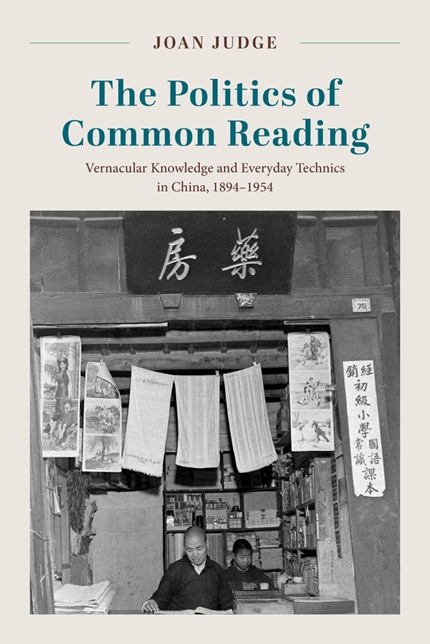
The Politics of Common Reading
Vernacular Knowledge and Everyday Technics in China, 1894–1954.
Book project by: Joan Judge
In The Politics of Common Reading, Joan Judge traces the unfolding of a consequential politics of accommodation that engaged commoners as knowers rather than as an unenlightened mass. A response to the institutional failures of the era, this politics was enacted through an informal knowledge infrastructure comprised of low-budget publishers, rustic bookstalls, and a piecemeal national network. As yet unstudied, this infrastructure produced and circulated up to ten times the number of books as official, mainstream channels.
Awarded the 2026 SHARP Book History Book Prize
Visit the website of the University of Chicago Press for more information.
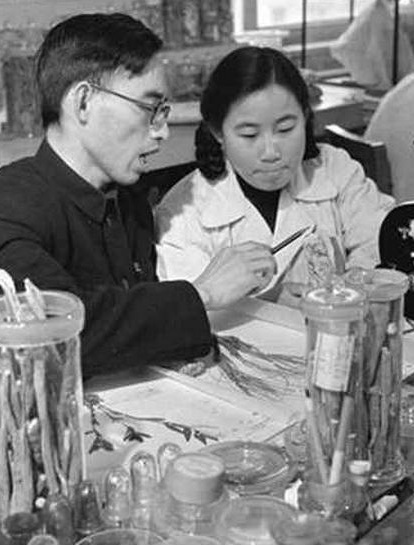
Medical Bilingualism: Reframing the Overlap between Medical Systems in Recent Medical History and Anthropology
Special Issue in Chinese Medicine and Culture, Volume 8, Issue 3 (2025).
Article by: Marta Hanson and Victor Kumar.
In this open access article, Marta Hanson and Victor Kumar engage with the concept of “medical bilingualism,” which refers to how people draw on and navigate between two distinctly different medical systems: for example, modern biomedicine and traditional Chinese medicine (TCM). They conduct experiments with AI tools to explore the usefulness of using AI developing a bibliography on “medical bilingualism,” and analyze how the impact of the COVID-19 pandemic on the development of the term.
Visit the website of Chinese Medicine and Culture to access the article.
Taking the Pulse between Early Modern China and Europe: The Drifting Touch
Book chapter in The Routledge History of the Senses.
Chapter by: Yijie Huang
Yijie’s book chapter, entitled ‘Taking the Pulse between Early Modern China and Europe: The Drifting Touch’, addresses the question by tracing a series of medical encounters at the Qing court and on the transcontinental voyage between the East and the West. It discloses how various participants in these encounters, from the Manchu emperor and his multiethnic courtiers to Chinese surgeons and merchants in the South and European missionaries and diplomats, tried to perceive the other’s pulse through their own culturally informed sense of touch. On that basis, it interrogates how such sensory endeavours created fluid realities of the body, disease, and medicinal objects which, in turn, concealed the sociocultural distinction between their associated ways of experiencing and knowing. In doing so, the chapter tackles critical aspects of the pre-modern global medical exchange beyond the narrative of (in)commensurability, and sheds light on the pivotal role of sensory experience in provoking resonance between practices and negotiating knowledges at a distance.
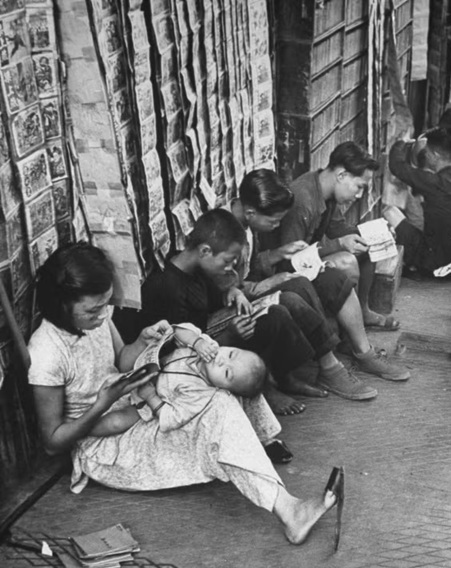
Common Knowers: Readers, Books, and the Making of Vernacular Knowledge in China
Lecture series at the University of Pennsylvania (in person and online), March 23 – 26, 2026.
Presented by: Joan Judge
In this series of three lectures, Joan Judge explores the relationship between physical books and historical common knowers in early twentieth century China. This is a challenging relationship to track. Common knowers are elusive; their acts of reading rarely documented. The books they used, the last vestiges of their reading and knowing processes, have been unevenly preserved and often dismissed as cultural detritus. In an age when digital technologies are both expanding the quantity of textual material available to us and skewing that archive toward what is most readily available and intellectually legible, the quest to find common knowers necessitates new methodologies. These methodologies begin with locating once widely consulted how-to books and thinking with them in innovative ways. They further entail developing digital tools that can help process these heterogenous materials and facilitate tracking — over global space and historical time — the repetitions, revisions, and transformations that signal the broader contours of common knowing.
Visit the website of the University of Pennsylvania Library for more information.