Traditional Medicine as an Integral Component of Global Healthcare Systems
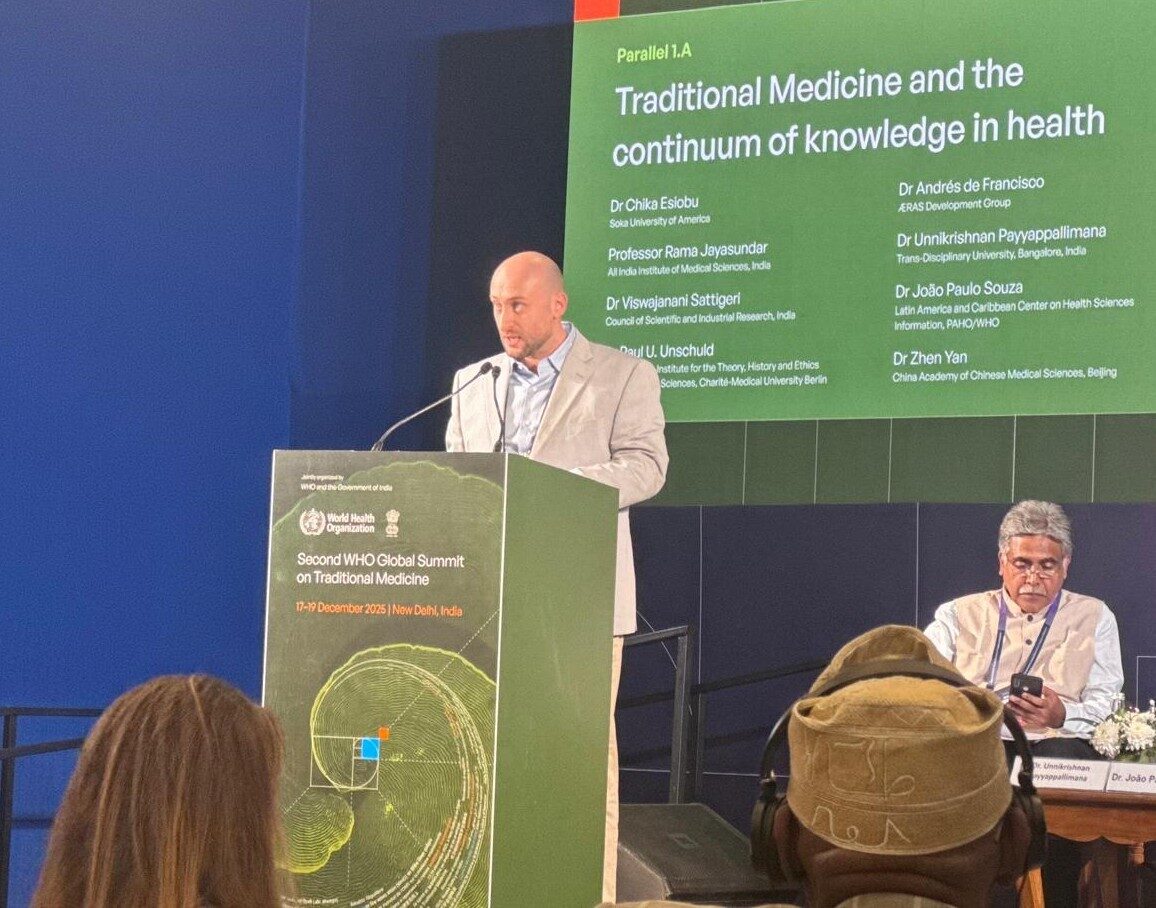
Talk at the Second WHO Global Summit on Traditional Medicine – New Delhi
December 17-19, 2025
Presented by: Joachim Prackwieser, in collaboration with Paul Unschuld and Nalini Kirk
The future of global health is increasingly defined by a dialogue between ancestral medical knowledge systems and contemporary scientific and technological innovation. This theme sat at the heart of the discussions at the WHO Global Summit on Traditional Medicine in New Delhi, India. The summit convened international experts from the fields of policy, science, and clinical practice to reimagine the role of traditional medicine within global healthcare frameworks.
Historical and Ethical Perspectives
Representing Professor Paul U. Unschuld, Joachim Prackwieser from the Institute for Chinese Life Sciences at the Charité Competence Center for Traditional and Integrative Medicine (CCCTIM), presented the historical and ethical dimensions of Chinese medicine during Parallel Session 1.A: “Traditional Medicine and the Continuum of Knowledge in Health.
Joachim Prackwieser demonstrated that medical knowledge has not evolved along a linear path of progress but has been shaped by shifting power asymmetries. He outlined how various models – spirituo-religious paradigms, natural philosophical concepts of Yin-Yang, pharmacological materialism, and finally modern biomedicine – gained prominence in China under specific social, moral, and political conditions. The contribution emphasized that contemporary “Traditional Chinese Medicine” (TCM) is a modern, selective reconstruction and that medical systems historically prevail not solely based on efficacy, but primarily due to their compatibility with dominant sociopolitical structures.
“Don’t Forget the Past“
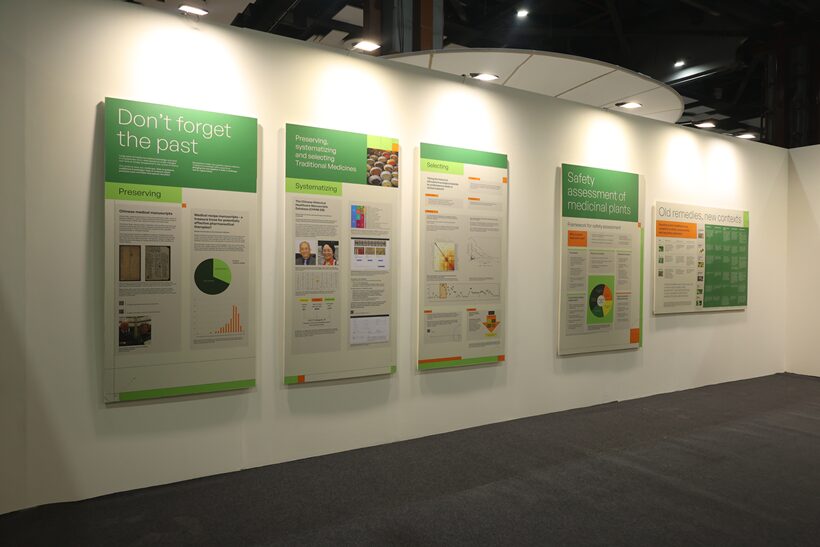
Parallel to the sessions, the exhibition “Don’t Forget the Past”—conceived by Joachim Prackwieser and Dr. Nalini Kirk—addressed the preservation, evaluation, and ethical integration of historical Chinese medical knowledge into current research. Drawing from work at the Institute for Chinese Life Sciences (ICL) at Charité, a three-stage methodological framework was introduced to bridge the gap between empirical tradition and the evidence-based requirements of modern biomedicine. This process involves the securing of historical sources (Preserve), the organization of fragmented knowledge into structured data (Systematize), and the utilization of data-driven analysis to identify promising therapeutic candidates (Select).
This approach was illustrated by the Chinese Historical Healthcare Manuscripts Database (CHHM-DB), which systematically catalogs over 41,000 medical recipes from 227 historical manuscripts. This database provides unprecedented access to rare sources and facilitates the identification of potentially active botanical compounds. In the “Select” section of the exhibition, a collaboration with the Dutch firm Precision Medicine Laboratory was featured. This partnership successfully demonstrated a pipeline from identifying candidate plants in historical texts to measuring molecular activity using nuclear receptor-based models.
The WHO Global Summit on Traditional Medicine
The second Global Summit, hosted by the World Health Organization (WHO), aimed to catalyze a global movement positioning traditional medicine as a vital element of sustainable, person-centered healthcare. Guided by the Global Traditional Medicine Strategy 2025–2034, the summit addressed critical issues including evidence generation, the bridging of innovation with rigorous clinical validation, and the navigation of policy challenges and epistemic boundaries. Furthermore, participants discussed the protection of biodiversity and intellectual property alongside the responsible use of new technologies.
Featured images @WHO