
Medical Advertising in Republican China
Double-click the images to view them in greater detail.
Analyzing two medical advertisements from Shenbao 申報
Translation by: Hugh Shapiro
Advertisements in Shenbao, one of China’s most widely read newspapers of the Republican period (1912-1949), show diverse socio-cultural phenomena, ranging from consumerist self-care to new ideas and forms of knowledge, to contemporary anxieties. These advertisements are a prime example of a vernacular medical commodity, demonstrating how medicines were popularized to a wider audience in the public sphere, and how advertising companies sought to capitalize on health-related anxieties. Hugh Shapiro, who is doing research on the history of disease in a comparative context, has translated two advertisements in Shenbao that reveal how medical knowledge was reframed for a broader reading public.
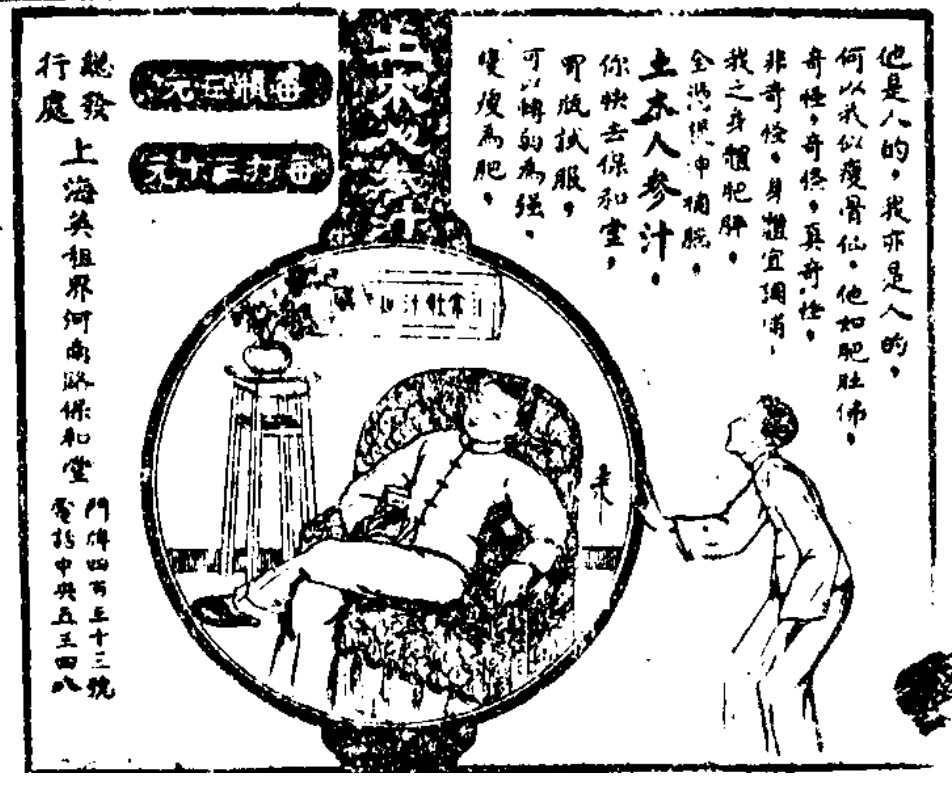
The first advertisement promotes an Earth-and-Wood Ginseng Decoction 土木人參汁, and can be found in the Shenbao issue published on September 26, 1928. The advertisement stresses how consuming this infusion can restore bodily vigor, transforming a weak and wasted frame into one that is strong, robust, and well-fleshed.
Translation:
Earth-And-Wood Ginseng Decoction 土木人參汁
He is human, and so am I, Yet why do I resemble a bony ascetic, while he looks a brawny machoman? 他是人的,我亦是人的, 何以我似殘骨仙,他如肥壯希?
It’s no mystery, my body is weak and wasted. Yet I’ve swallowed a divine tonic—Earth-And-Wood Ginseng Decoction. 非奇怪,身體虛脫, 我已經服用神補藥——土木人參汁。
Make haste to the Bao He Tang Pharmacy and buy a few bottles to imbibe, It can turn a frail body robust, And make the thin grow fat. 你快去保和堂買幾瓶來服, 可以將瘦弱的身體變為強健, 並使瘦人變成肥胖
Main distribution center, Shanghai British Concession, Henan Road, Bao He Tang Pharmacy. 總發行處,上海英租界河南路.
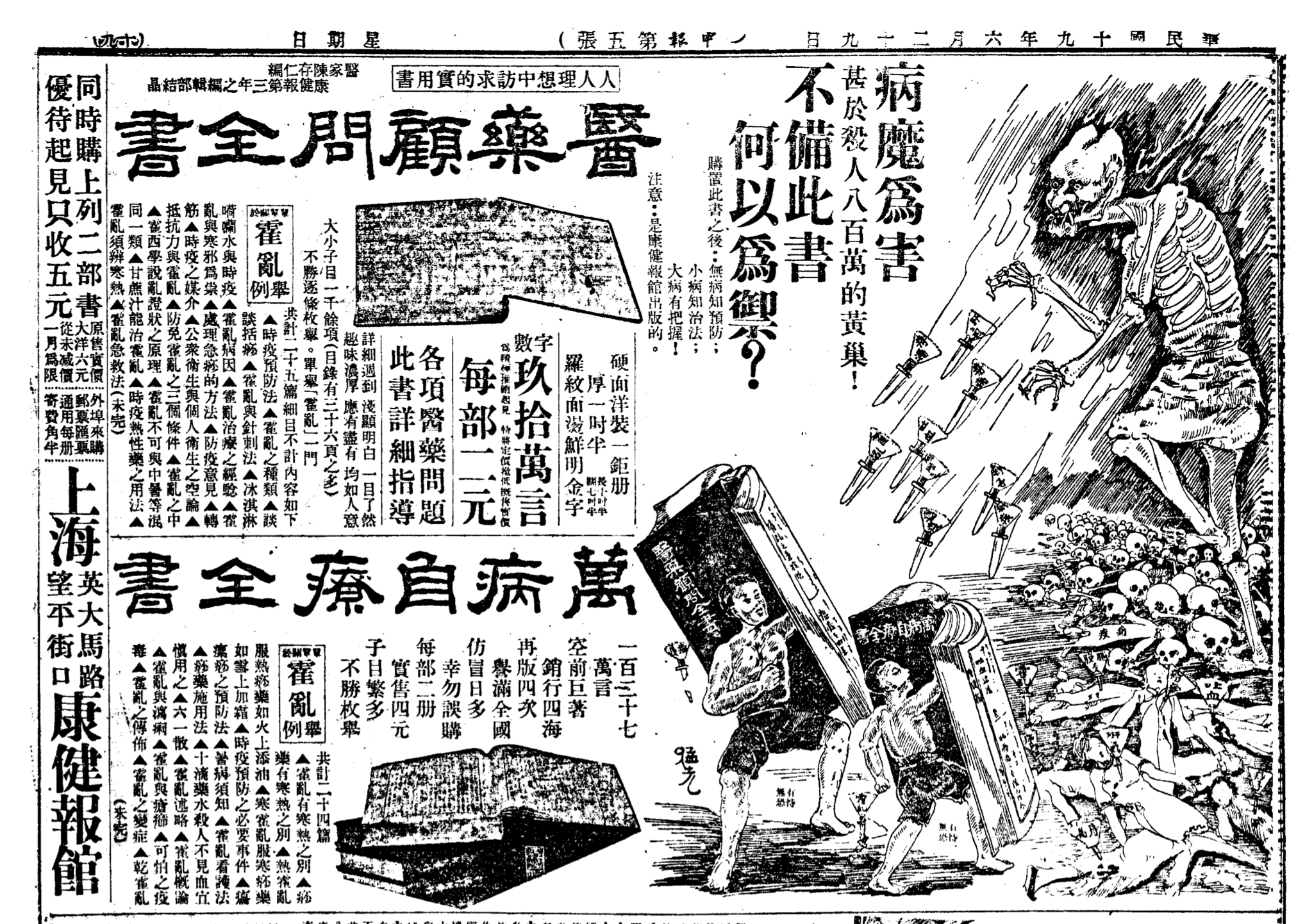
The second advertisement dates from June 29, 1930. It’s summer and the advertisement highlights cholera and its management, and what can be learned from the indispensable medical handbooks. The advertisement shows a demon of disease hurling toxic daggers at two boys. The shirtless boys defend themselves from the menacing pathogens, each with an open book, the contents—the words—facing the fiend. Their sturdy shields are medical compendia for householders. Impenetrable. A toxic dagger with the phrase “cholera” 霍亂 strikes the ground near their feet, the disease misses its mark. With a hideous monster’s face and a decomposed skeletal body, the hulking demon’s bony feet crush the skulls of past victims. A field of corpses in different states of decay. Infectious blades jut from the freshly slain. On the knives are written the names of dangerous diseases and conditions: Tuberculosis 癆病, Cholera 霍亂, Spitting blood 吐血, Brain prolapse 腦脫, Measles 痧子, Dysentery 痢疾; Hemorrhoids 痔. That the deceased did not benefit from the protection of these medical encyclopedias is tragic.
Two books, The Encyclopedia of Medical Consultations 醫藥顧問全書 and The Complete Compendium for Self-Treatment of the Myriad Disorders 萬病自療全書 are advertised next to the image for a discounted price of five Yuan (the original fixed price was six Yuan). The titles of these works are also displayed on the books held by the boys in the drawing to defend themselves against disease.
Translation:
The scourge of disease (the demon of illness), wreaks havoc, 病魔為害
Worse than the (infamous 9th-century Tang Dynasty rebel) Huang Chao, who killed eight million! 甚於殺人八百萬的黃巢!
Without this book at hand, 不備此書
How can one defend against it? 何以為禦?
This is the practical book that everyone is seeking. 人人理想中訪求的實用書
Note: It is published by the Good Health (Kangjian) Newspaper Office.
注意:是康健報館出版的
Sources:
Shenbao 申报,September 26, 1928, p. 19, Issue no. 19947.
Shenbao 申报, June 29, 1930, p. 19, Issue no. 20564.
Images courtesy of Hugh Shapiro.
For more information on medical advertisements in the Shenbao, see, for example, Huang, Max K.W. “Medical Advertising and Cultural Translation: The Case of Shenbao in Early Twentieth-Century China.” In Print, Profit, and Perception Ideas, Information and Knowledge in Chinese Societies, 1895–1949, edited by Pei-yin Lin and Weipin Tsai, 114-147. Leiden: Brill, 2014; and Cochran, Sherman “Marketing Medicine and Advertising Dreams in China, 1900-1950.” In: Becoming Chinese Passages to Modernity and Beyond edited by Wen-hsin Yeh, 62-97. Los Angeles, CA: University of California Press, 2000.